
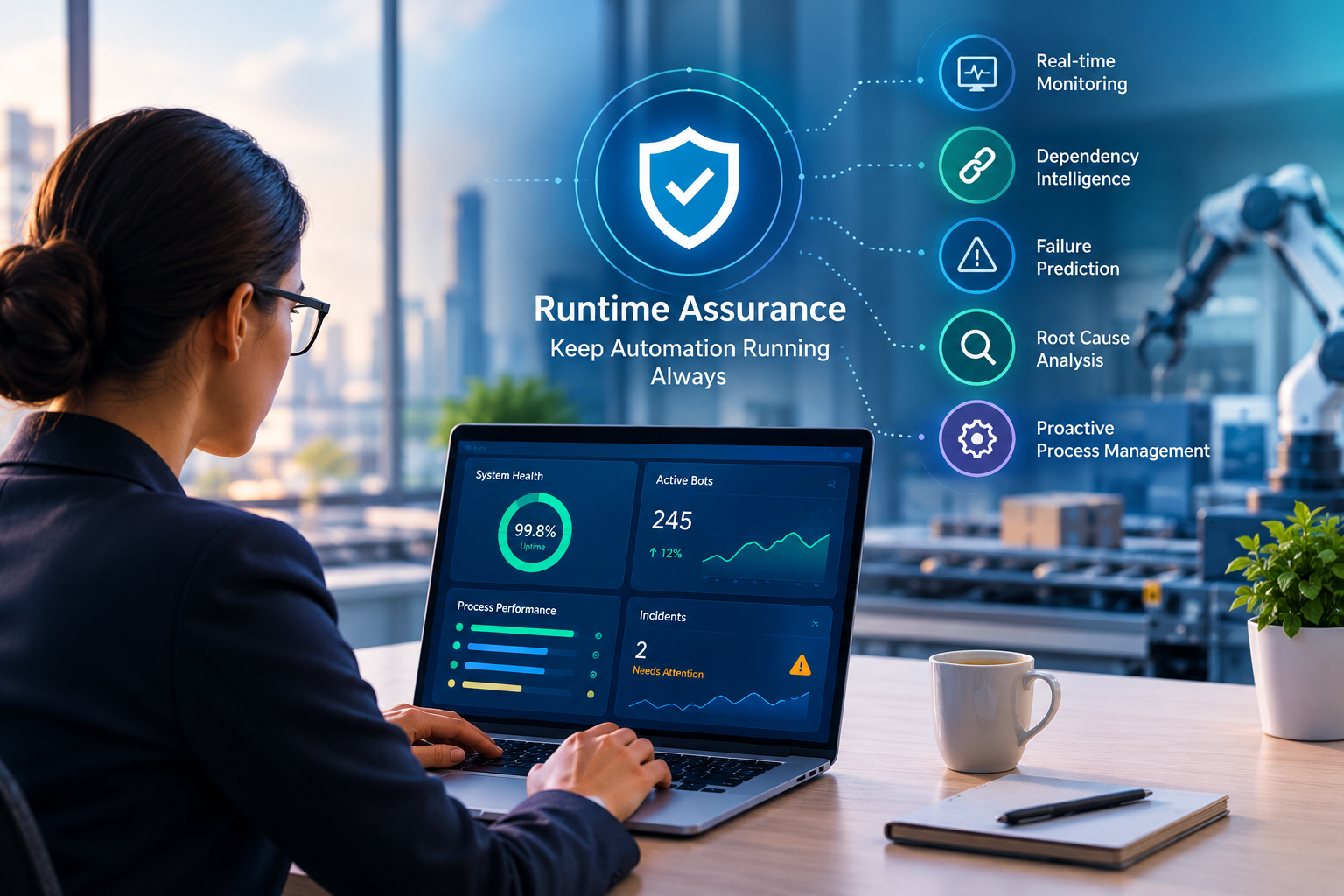
Enterprise automation can save hours of manual work, reduce operational costs, and help teams handle complex business processes. But what happens when an automated workflow stops working, a system dependency fails, or a bot produces an unexpected result? Even a small issue can disrupt an entire business operation when multiple systems depend on one another.
This is where runtime assurance becomes important. It helps enterprises maintain visibility into automation performance while identifying potential issues during execution. Instead of focusing only on whether an automation works during testing, businesses can pay attention to how it behaves in real operating conditions.
For organizations expanding automation across departments, runtime assurance provides a practical way to manage reliability, minimize disruption, and maintain control as operations grow.
What Is Runtime Assurance in Enterprise Automation?
Runtime assurance is the practice of monitoring an automated process while it is running, checking whether it behaves as expected, and identifying conditions that could affect its reliability.
Traditional testing checks whether an automation is ready for use. Runtime assurance focuses on what happens after it enters production. It helps teams identify execution errors, unexpected behavior, performance changes, and system dependency issues before they cause wider operational problems.
Consider a financial services company that uses automation to process loan applications. The workflow collects customer information, validates documents, checks eligibility, and updates the banking system. If a system interface changes or a required service becomes unavailable, the workflow may fail midway.
With runtime assurance, the operations team can detect the interruption, investigate its cause, and take corrective action. This reduces the risk of incomplete applications, processing delays, and unnecessary manual intervention.
Why Do Enterprises Need Runtime Assurance?
As organizations scale automation, managing individual bots and workflows becomes more complicated. Processes often depend on shared databases, APIs, enterprise applications, and third party services. A problem in one component can affect several connected workflows.
Here are three reasons why runtime assurance matters.
- Preventing Operational Disruptions
Automation failures can delay customer requests, interrupt transactions, and create backlogs. Early alerts help teams respond before a minor issue develops into a larger operational incident.
- Improving Visibility Across Workflows
When automation operates across multiple departments, teams need a clear view of execution status, error patterns, and performance. Better visibility helps operations leaders understand which workflows require attention and where recurring problems originate.
- Supporting Business Continuity
Enterprises cannot always afford to stop critical processes while teams investigate technical issues. Runtime assurance helps organizations identify failures quickly, prioritize incidents, and restore normal operations with less disruption.
How Does Runtime Assurance Work?
Runtime assurance combines continuous monitoring, performance checks, alerting, and incident analysis to help maintain dependable automation.
1. Monitor Automation Execution
The process begins by tracking workflow activity, execution status, processing times, and exceptions. This information helps teams understand whether an automation is operating within its expected parameters.
2. Identify Abnormal Behavior
Monitoring becomes more useful when teams can recognize unusual patterns. Repeated failures, unexpected processing delays, missing data, or sudden changes in execution time may indicate a developing problem.
3. Analyze Dependencies
Enterprise workflows rarely operate in isolation. They may depend on databases, APIs, credentials, network connectivity, and business applications. Dependency monitoring helps teams identify whether an external component is responsible for a failure.
4. Alert the Right Teams
When an issue requires attention, relevant alerts help support teams investigate. Prioritizing incidents according to business impact allows teams to address critical workflows before less urgent issues.
5. Support Root Cause Analysis
Finding the immediate error is not always enough. Root cause analysis helps teams understand why the issue occurred, whether it has happened before, and what changes could prevent it from recurring.
Depending on the platform and its configuration, teams may also automate recovery actions or route incidents to the appropriate support personnel.
Runtime Assurance vs. Traditional Automation Monitoring
Automation monitoring and runtime assurance are closely related, but their objectives can differ.
Basic monitoring typically reports whether a bot is running, has completed a task, or has encountered an error. Runtime assurance takes a broader operational view by examining execution behavior, dependencies, reliability risks, and the business impact of failures.
For example, a monitoring dashboard may report that an invoice processing bot has stopped. A more comprehensive assurance approach can help investigate whether a database outage, an application update, or a recurring exception caused the interruption.
The distinction depends on the capabilities of the platform. Monitoring is an important part of runtime assurance, but reliable operations also require effective investigation, incident handling, and follow through.
How Enterprises Can Implement Runtime Assurance
A successful implementation starts with business priorities rather than technology alone.
First, identify critical workflows based on transaction volume, customer impact, compliance requirements, and the cost of downtime. Next, establish performance baselines so teams know what normal execution looks like.
Define clear thresholds for processing delays, failure rates, and other operational indicators. Configure alerts to reach the teams responsible for resolving each type of incident. Review recurring failures regularly and use the findings to improve workflow design, exception handling, and system dependencies.
Enterprises should also establish ownership for each automated process. When responsibility is unclear, even well detected incidents can remain unresolved longer than necessary.
An enterprise automation monitoring platform can bring execution data, alerts, and dependency information into a shared operational view. The right solution should fit the existing technology environment and provide information that teams can use to make timely decisions.
The Role of AutomationCOE in Runtime Assurance
As automation expands across business units, a centralized approach helps maintain consistent operational standards. An Automation Center of Excellence, or Automation CoE, can define monitoring practices, establish incident management procedures, and clarify accountability across teams.
AutomationCOE focuses on automation intelligence and runtime assurance through AURA, its Automated Uptime and Runtime Assurance offering. This aligns with the need for stronger visibility into automation operations and a more structured approach to identifying and investigating issues.
By connecting operational oversight with established governance practices, enterprises can manage automation more consistently instead of relying on separate teams to solve similar problems independently.
Conclusion
Runtime assurance helps enterprises move beyond simply launching automated workflows toward maintaining dependable operations over time. It provides a structured approach to detecting abnormal behavior, understanding dependencies, investigating failures, and reducing disruption.
As automation becomes more closely connected to business critical systems, reliability must be treated as an ongoing responsibility. Organizations that establish clear monitoring practices, incident ownership, and performance standards are better positioned to scale automation while maintaining operational control.
