
In the rapidly evolving world of advanced electronics and high-performance technologies, thermal management has become one of the most critical engineering challenges. As electronic devices become smaller, faster, and more powerful, the amount of heat generated within these systems continues to increase significantly. Efficient heat dissipation is no longer optional it is essential for maintaining reliability, performance, and operational longevity.
Among the most advanced materials developed to address these challenges are Single Crystal Diamond Wafers. Known for their exceptional thermal conductivity, structural stability, and superior material properties, these engineered diamond substrates are revolutionizing thermal management across industries such as semiconductors, aerospace, telecommunications, defense, and quantum technologies.
This comprehensive guide explores the growing importance of Single Crystal Diamond Wafers, their unique characteristics, applications, manufacturing methods, and why they are considered one of the most advanced solutions for high-performance heat spreading.
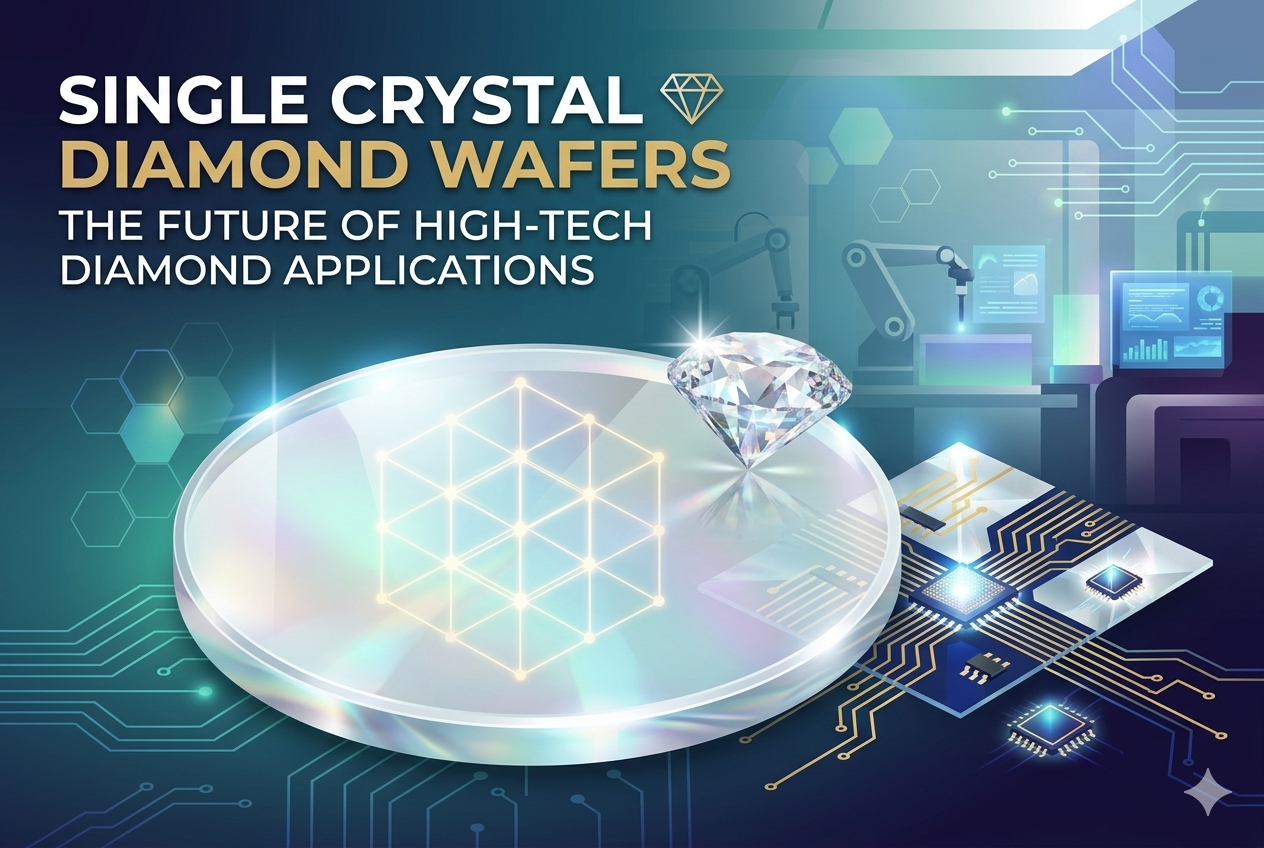
What Are Single Crystal Diamond Wafers?
Single Crystal Diamond Wafers are synthetic diamond substrates manufactured with a continuous and uninterrupted crystal lattice structure. Unlike polycrystalline diamonds, which contain multiple crystal grains and boundaries, single crystal diamonds consist of one uniform crystal orientation throughout the entire wafer.
This flawless crystal structure provides several advantages:
- Extremely high thermal conductivity
- Exceptional mechanical strength
- Superior optical properties
- Enhanced electrical insulation
- Improved reliability in advanced applications
These unique characteristics make Single Crystal Diamond Wafers highly valuable for demanding industrial and technological environments.
Why Thermal Management Matters in Modern Technologies
Today’s electronic and photonic systems generate enormous amounts of heat in compact spaces. Industries developing high-power semiconductors, AI processors, laser systems, and communication devices require materials capable of efficiently managing thermal loads.
Without proper heat management, systems may experience:
- Reduced operational efficiency
- Device overheating
- Performance instability
- Premature component failure
- Increased maintenance costs
Traditional materials such as copper and aluminum often struggle to meet the demands of modern high-density electronics. This is where Single Crystal Diamond Wafers provide a groundbreaking solution.
Due to their unmatched thermal conductivity, these wafers can rapidly transfer heat away from sensitive components, ensuring stable performance even under extreme operating conditions.
Key Properties of Single Crystal Diamond Wafers
1. Exceptional Thermal Conductivity
One of the most important characteristics of Single Crystal Diamond Wafers is their extraordinary thermal conductivity, which is significantly higher than conventional heat-spreading materials.
Benefits Include:
- Rapid heat dissipation
- Reduced thermal hotspots
- Improved device stability
- Enhanced system efficiency
This makes them ideal for applications where temperature control is critical.
2. Low Thermal Expansion
Single Crystal Diamond Wafers exhibit very low thermal expansion, meaning they maintain dimensional stability even under large temperature variations.
Advantages:
- Reduced thermal stress
- Lower risk of cracking or deformation
- Improved reliability in sensitive systems
This property is especially important in semiconductor and aerospace applications where precision is essential.
3. High Mechanical Strength
Diamond is the hardest known material, and Single Crystal Diamond Wafers inherit this remarkable durability.
Industrial Benefits:
- High wear resistance
- Long operational lifespan
- Resistance to harsh environments
Their mechanical stability makes them suitable for high-performance industrial systems.
4. Electrical Insulation Properties
Unlike metallic heat spreaders, diamond provides excellent electrical insulation while maintaining superior thermal conductivity.
Why This Matters:
- Prevents electrical interference
- Improves safety in electronic systems
- Supports high-frequency device performance
This unique combination makes Single Crystal Diamond Wafers highly effective in advanced electronics and communication technologies.
Applications of Single Crystal Diamond Wafers
Semiconductor Industry
The semiconductor industry is one of the largest adopters of Single Crystal Diamond Wafers due to increasing power densities in modern chips and devices.
Common Applications:
- High-power transistors
- RF devices
- Laser diodes
- Microprocessors
- Power electronics
Efficient thermal management helps improve performance, reduce overheating, and extend component lifespan.
Quantum Technologies
Quantum systems require highly stable thermal environments to preserve delicate quantum states and ensure accurate operations.
Single Crystal Diamond Wafers are used in:
- Quantum computing systems
- Quantum sensors
- Photonic quantum devices
Their purity and thermal properties make them ideal for next-generation quantum applications.
Aerospace and Defense
Aerospace systems operate under extreme conditions, requiring materials that combine thermal efficiency with durability.
Applications Include:
- Satellite systems
- Radar electronics
- Avionics
- Defense communication systems
Single Crystal Diamond Wafers provide reliable thermal performance while maintaining lightweight system designs.
Telecommunications and 5G Networks
Modern communication systems generate significant heat due to high-frequency operations and compact device architectures.
These wafers help:
- Maintain signal stability
- Improve device efficiency
- Enhance network reliability
As 5G infrastructure expands, demand for advanced thermal solutions continues to grow.
Optical and Photonic Systems
Due to their exceptional optical transparency and durability, Single Crystal Diamond Wafers are also widely used in optical technologies.
Key Uses:
- Laser windows
- Optical lenses
- Infrared transmission systems
- High-power photonic devices
Their performance under extreme temperatures makes them valuable for advanced photonic applications.
Manufacturing Process of Single Crystal Diamond Wafers
The production of Single Crystal Diamond Wafers requires advanced manufacturing technologies to ensure high purity and precise crystal growth.
MPCVD Technology
Microwave Plasma Chemical Vapor Deposition (MPCVD) is one of the most advanced methods used for manufacturing synthetic diamond wafers.
How It Works:
- Microwave energy generates plasma inside a controlled chamber
- Carbon-rich gases are introduced
- Carbon atoms deposit layer by layer onto a substrate
- A high-quality diamond crystal gradually forms
Advantages of MPCVD:
- Precise crystal growth control
- Minimal impurities
- High thermal and optical quality
- Customizable wafer specifications
This technology has become essential for producing advanced Single Crystal Diamond Wafers for industrial applications.
Advantages Over Traditional Heat Spreading Materials
Compared to conventional materials like copper, aluminum, and ceramics, Single Crystal Diamond Wafers offer several advantages:
| Property | Single Crystal Diamond | Copper |
|---|---|---|
| Thermal Conductivity | Extremely High | Moderate |
| Electrical Insulation | Excellent | Poor |
| Thermal Expansion | Very Low | Higher |
| Durability | Exceptional | Moderate |
These superior properties make diamond wafers ideal for advanced thermal management systems.
Challenges in Adoption
Despite their advantages, certain challenges still exist:
- High production costs
- Complex manufacturing processes
- Limited large-scale availability
- Need for specialized expertise
However, continuous advancements in synthetic diamond manufacturing are steadily reducing costs and increasing accessibility.
Future of Single Crystal Diamond Wafers
The future of Single Crystal Diamond Wafers looks exceptionally promising as industries continue pushing the boundaries of technology.
Emerging applications include:
- Artificial intelligence hardware
- Electric vehicle power systems
- Quantum computing infrastructure
- Advanced aerospace electronics
- Next-generation communication systems
As demand for high-performance thermal solutions grows, these diamond wafers are expected to become increasingly important across multiple industries.
Conclusion
Single Crystal Diamond Wafers represent one of the most advanced material innovations in modern thermal management and high-performance technology applications. Their unmatched thermal conductivity, durability, electrical insulation, and structural stability make them indispensable in industries ranging from semiconductors and telecommunications to aerospace and quantum technologies.
As electronic systems continue to become more compact and powerful, the need for efficient heat dissipation solutions will only increase. Single Crystal Diamond Wafers are not only addressing today’s thermal challenges but also paving the way for the next generation of technological innovation.
Investing in Single Crystal Diamond Wafers means investing in the future of performance, reliability, and advanced engineering excellence.
